
Scott County Civil Docket Searches
Start with the type of case. Circuit Court carries the general civil lane. That lane is for claims not placed somewhere else by law. Chancery Court keeps its own docket for divorce, custody, alimony, estates, guardianships, conservatorships, land and title, equity, adoptions, and commitments. Justice Court handles small claims up to $3,500 and related matters. Scott's official pages list no local County Court. So do not route a civil search to a division that does not exist.
Once you know the lane, pick the tool. Use the Eighth Circuit MEC query for an eligible Circuit case. Use the Second Chancery MEC query for an eligible Chancery case. Both public pages stop at the Login, Password, and client-code layer. PAMEC registration gives remote read-only access. Without a subscription, the clerk's office is the fallback for electronic viewing. Justice Court small claims sit outside both MEC paths.
- Read the caption, pleading, summons, or order and identify Circuit, Chancery, or Justice Court.
- Create or use a PAMEC account for remote Circuit or Chancery docket access.
- Search with the strongest available identifier after authentication; the public login page does not reveal all later filters.
- Read process, responses, motions, settings, orders, and any judgment as separate docket events.
- Call the responsible clerk for older files, a current setting, or a public plain or certified document.
Scott County Circuit or Chancery Dockets
The real distinction in a Scott County civil docket search is Circuit versus Chancery. Circuit Court takes general civil matters not assigned exclusively to another court. The Circuit Clerk receives the complaints, answers, motions, process, judgments, and executions. Chancery Court owns the domestic side: divorce and custody, estates, guardianships, conservatorships, land, title, equity, adoption, and commitments. The Chancery Clerk keeps that separate court record.
Let the claim type and the court named on the paperwork guide you. A divorce, estate, or guardianship belongs in Chancery. A general civil filing may belong in Circuit. If the venue is unclear, call the clerk. Do that before paying for remote pages or mailing a written request. Both electronic routes are part of Mississippi Electronic Courts, but they stay distinct.
| Scott County civil route | Typical matters | Custodian and access |
|---|---|---|
| Circuit Court | General civil cases, judgments, executions, and lower-court appeals | Circuit Clerk and Eighth Circuit MEC/PAMEC |
| Chancery Court | Divorce, custody, estates, guardianships, land, title, and equity | Chancery Clerk and Second Chancery MEC/PAMEC |
| Justice Court | Small claims up to $3,500 and related lower civil matters | Justice Court Clerk, phone and counter route |
Civil Dockets: What They Show
Think of a Scott County civil docket as the chronological register behind the case file. It can list the case number, filing date, court, judge or chancellor, caption, parties, subject area, pleadings, process, motions, notices, orders, settings, judgment, and post-judgment activity. No public login screen offers a reliable local case-number pattern. Take the case number from the actual court paper instead of guessing.
Every entry does a different job. A complaint or petition starts the record. Process entries track a summons or citation being issued and returned. An answer or counterclaim responds. A notice of hearing marks a proposed setting, not a ruling. A signed order is what shows court action. For a final judgment, agreed judgment, default judgment, nonsuit, dismissal, or appeal, read the order itself. Do that where public access allows.
| Header | Case number, filing date, court, judge or chancellor, caption, and current status when displayed. |
|---|---|
| Parties and subject | Plaintiff and defendant, or petitioner and respondent, plus the civil or Chancery subject area. |
| Process and responses | Summons or citation issuance and return, answer, counterclaim, cross-claim, or appearance. |
| Motions and settings | Requests, notices, hearings, continuances, and later orders that explain what occurred. |
| Judgment and later events | Final or agreed judgment, dismissal, appeal, execution, satisfaction, cost, or other post-judgment entry. |
Scott County Second Chancery MEC
Chancery cases in Scott County are heard by the Second Chancery District. Jasper and Newton counties sit in that district too. That grouping is why a Chancery docket uses its own MEC query route. It does not use the Eighth Circuit page. The official Court Information record places Scott Chancery Court at 100 Main Street in Forest. It notes the 2019 MEC go-live date. The record also lists regular-hours phone contact. The Chancery Clerk keeps the filed record and issues certified copies.
The Second Chancery MEC query presents the same public login screen as the Circuit route. It asks for Login, Password, and a client code. The search fields open only after you sign in with an account. So bring a case number or party name with you. The court publishes no free field list, date-range rule, or result limit. That applies to visitors outside the system.
For the official Scott County civil docket entry point, the Second Chancery MEC authentication page shows the login that guards Chancery case records for the district.
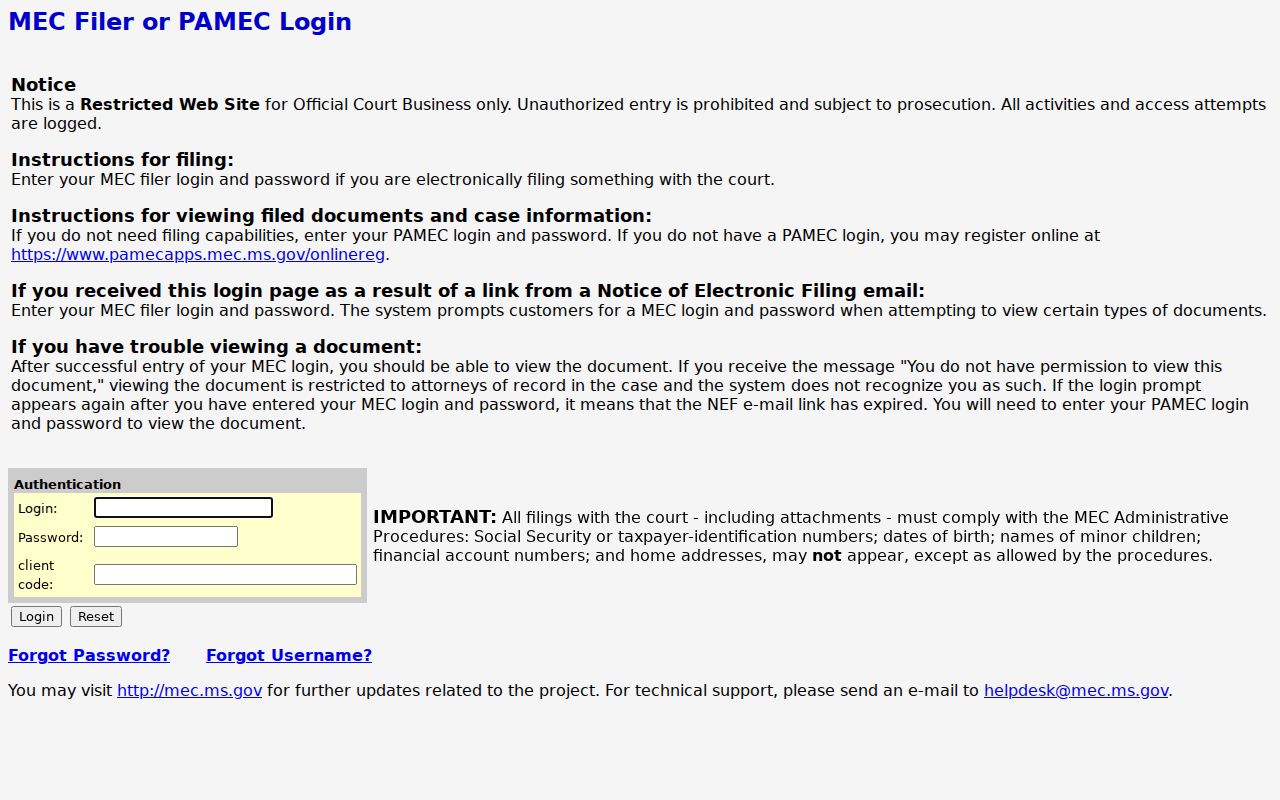
What appears here is the account boundary for remote civil docket access, not an open public civil case record.
What Cases Fill the Civil Docket
Jurisdiction decides where a Scott County civil record lives. Circuit Court receives ordinary general civil matters not exclusively assigned elsewhere. The Chancery docket covers domestic relations. It also takes estates, guardianships, conservatorships, property, equity, and land or title disputes. Justice Court offers a lower civil route for small claims. County material lists no separate Scott County Court. Do not borrow one from another Mississippi county.
- Circuit civil complaints, motions, judgments, executions, and appeals from lower courts.
- Chancery divorce, custody, alimony, estate, guardianship, conservatorship, and equity matters.
- Chancery land, title, property, adoption, and commitment matters, subject to restrictions where applicable.
- Justice Court small claims up to $3,500 and related civil matters.
- Post-judgment filings such as execution, garnishment, satisfaction, cost bill, or appeal where the docket shows them.
Scott County Chancery Docket Flags
Flags on the Second Chancery MEC docket label the record task at hand. You might see Accounting Filed - Order Due, Conservator Plan, Guardian Plan, Inventory Waived, Minor Ward, SHOW CAUSE ORDER, TRUST, MEDIATION, APPEAL, SEALED, or RESTRICTED BY ORDER. None of them is a verdict. A flag is a label, not a ruling. It never substitutes for the docket entry or the signed order itself.
Some flags point to paperwork. A guardian-plan or accounting flag, for instance, signals that a report or order task is pending in a guardianship or conservatorship. It does not reveal what is inside that report. SEALED and RESTRICTED BY ORDER speak to access, not outcome. For an official answer, request any legally available order. Or ask the Chancery Clerk what public information can be viewed.
- MEDIATION
- A status showing mediation activity or a related entry, not proof that a settlement was reached.
- Inventory Waived
- A Chancery flag connected to an inventory requirement; the underlying order supplies the meaning.
- SHOW CAUSE ORDER
- A court order requiring a response or appearance, whose terms must be read in the filed order.
- RESTRICTED BY ORDER
- An access designation that can limit remote viewing of material in the court file.
Hearings on the Civil Docket
Civil hearings surface in the docket through notices, hearing entries, orders, docket calls, and trials. Continuances and resets come later. The public login layer offers no authenticated Scott calendar screen. So confirm any date from the newest docket entry, the signed order, or the clerk. The Circuit term calendar covers broad sitting periods only, not your courtroom or hearing time. Remember that a notice of hearing does not prove a hearing happened. A motion filed is not a ruling.
Before you call, gather the case number, the last notice date, and the court name. Circuit questions go to 601-469-3601. Chancery questions go to 601-469-1922. Justice Court questions go to 601-469-4555. Ask whether the setting still stands, what time and courtroom apply, and whether a reset or later order controls. The full date-confirmation path is on the Scott County Court Schedule.
Scott County Older Equity Files
An older Scott County equity or Chancery case may be absent from a remote MEC search. The clerk may still hold a file, minute book, bound docket, microfilm, or archive record. Some of these record systems predate electronic access entirely. There is no complete start date for every electronic image and no public archive index. The practical fix is a narrow written request to the Chancery Clerk. Include the case caption and approximate date. Add the subject and any known case number.
Ask where the older record lives. It might be the current MEC database, a paper file, a bound volume, or an archive retrieval process. Get an estimated charge before ordering copies. A blank online result does not prove the civil case never existed. It usually means a clerk search or an in-person review is the route instead. The official Scott County Chancery Clerk page shows the office that handles this Scott County civil docket clerk work.
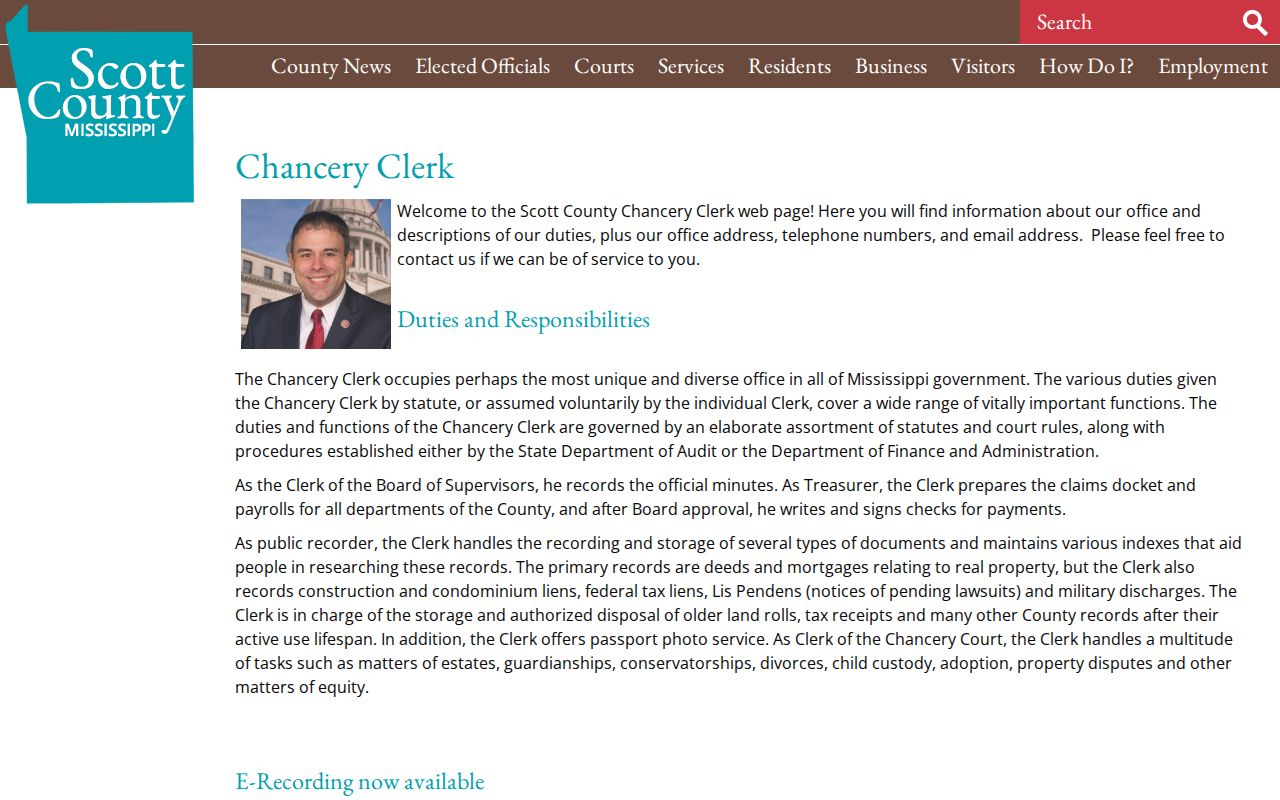
Older civil files: that office image ties an older civil-file question to the Chancery Clerk, who keeps the court's separate docket lane.
Who Can See Civil Dockets
Who decides access to a Scott County civil docket? The court does, along with the clerk, Mississippi law, and any sealing or restriction order. PAMEC gives account holders read-only remote access to eligible electronic cases. MEC procedures also allow free electronic viewing at the clerk's office during regular hours. Copies cost extra. A clerk can tell you whether a plain or certified public copy exists. A public-record request can seek a maintained record. It cannot override adoption confidentiality, Youth Court confidentiality, protected reports, commitment restrictions, or a court order.
Access rules: Mississippi Code §25-61-2 states the Public Records Act policy of inspection unless an exemption applies, while §25-61-5 addresses access procedures and redaction. MEC procedures separately limit sealed cases and documents. A public docket line can be available even where an image or report is restricted.
The Second Chancery MEC Court Information page shows the Scott County civil docket access channel.
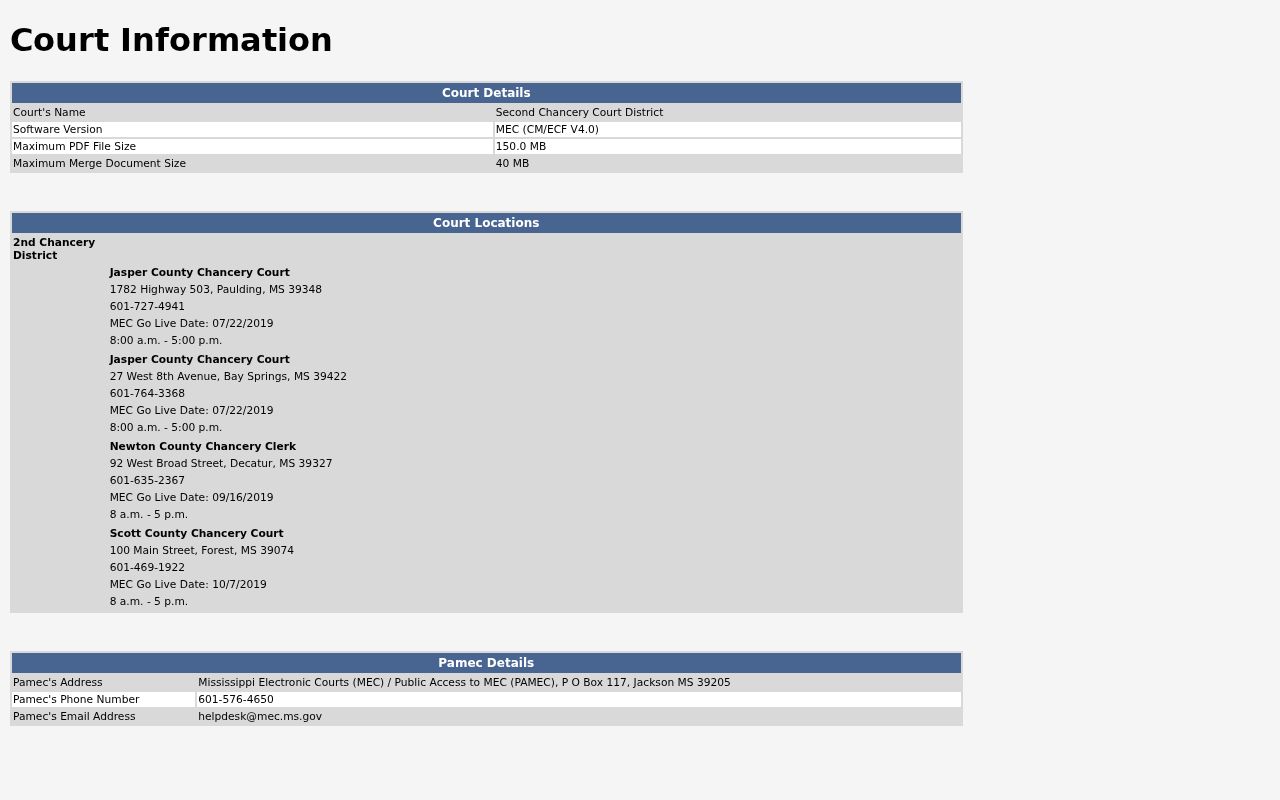
That display confirms the Scott Chancery MEC access route. It does not displace the clerk's role with restricted or certified records.
Scott County Civil Judgment Records
A civil judgment entry tells you the court entered an order. It may not show what followed: payment, satisfaction, enforcement, appeal, or later modification. Read the signed judgment and the docket entries after it. A final judgment, agreed judgment, default judgment, nonsuit, or dismissal for want of prosecution each carries its own meaning. So does a CLOSED label. When formal proof is needed, ask the clerk's office for a certified judgment.
Copy costs differ by court. Circuit Clerk fee material lists $1 to certify a complete filed document. A clerk-made copy runs $1 per page. Chancery fee material lists $1 for certification and $0.50 per clerk-made page. Confirm totals with the clerk. Delivery, redaction, copying, and the document itself can change the bill. The PAMEC per-page viewing charge is not a certified-copy fee.
| Record question | Best Scott County channel |
|---|---|
| Eligible Circuit or Chancery docket history | PAMEC/MEC after account registration |
| Older or unavailable electronic file | Responsible Circuit or Chancery Clerk |
| Small claim or lower civil matter | Justice Court Clerk at 601-469-4555 |
| Certified judgment or order | The clerk that maintains the underlying case file |
Scott County Civil and Federal Courts
A Scott County Circuit or Chancery civil case runs through the Mississippi state-court channels described above. Federal civil matters are a separate world. They use PACER and the federal CM/ECF system for the Southern District of Mississippi. A PACER result is not a Scott County civil docket result. A PAMEC search is not a federal-court search. Read the court caption first. It keeps you in the right portal. The Southern District of Mississippi CM/ECF lookup shows the federal side of that state-versus-federal civil access split.
The federal route appears here only to keep the two systems straight. Scott County civil court dockets stay with the state court and clerk channels.